Compact System

  • Subscribe to our RSS feed.
  • Twitter
  • StumbleUpon
  • Reddit
  • Facebook
  • Digg

Monday, 22 August 2011

Google at the Joint Statistical Meetings in Miami

Posted on 15:06 by Unknown
Posted by Marianna Dizik, Statistician

The Joint Statistical Meetings (JSM) were held in Miami, Florida, this year. Nearly 5,000 participants from academia and industry came to present and discuss the latest in statistical research, methodology, and applications. Similar to previous years, several Googlers shared expertise in large-scale experimental design and implementation, statistical inference with massive datasets and forecasting, data mining, parallel computing, and much more.

Our session "Statistics: The Secret Weapon of Successful Web Giants" attracted over one hundred people; surprising for an 8:30 AM session! Revolution Analytics reviewed this in their official blog post "How Google uses R to make online advertising more effective"

The following talks were given by Googlers at JSM 2011. Please check the upcoming Proceedings of the JSM 2011 for the full papers.

  • Statistical Plumbing: Effective use of classical statistical methods for large scale applications
    • Author(s): Ni Wang, Yong Li, Daryl Pregibon, and Rachel Schutt
  • Parallel Computations in R, with Applications for Statistical Forecasting
    • Author(s): Murray Stokely and Farzan Rohani and Eric Tassone
  • Conditional Regression Models
    • Author(s): William D. Heavlin
  • The Effectiveness of Display Ads
    • Author(s): Tim Hesterberg and Diane Lambert and David X. Chan and Or Gershony and Rong Ge
  • Measuring Ad Effectiveness Using Continuous Geo Experiments
    • Author(s): Jon Vaver and Deepak Kumar and Jim Koehler
  • Post-Stratification and Network Sampling
    • Author(s): Rachel Schutt and Andrew Gelman and Tyler McCormick
Google has participated at JSM each year since 2004. We have been increasing our involvement significantly by providing sponsorship, organizing and giving talks at sessions and roundtables, teaching courses and workshops, hosting a booth with new Google products demo, submitting posters, and more. This year Googlers participated in sessions sponsored by ASA sections for Statistical Learning and Data Mining, Statistics and Marketing, Statistical Computing, Bayesian Statistical Science , Health Policy Statistics, Statistical Graphics, Quality and Productivity, Physical and Engineering Sciences, and Statistical Education.

We also hosted the Google faculty reception, which was well-attended by faculty and their promising students. Google hires a growing number of statisticians and we were happy to participate in JSM again this year. People had a chance to talk to Googlers, ask about working here, encounter elements of Google culture (good food! T-shirts! 3D puzzles!), meet old and make new friends, and just have fun!

Thanks to everyone that presented, attended, or otherwise engaged with the statistical community at JSM this year. We’re looking forward to seeing you in San Diego next year.
Read More
Posted in conferences, jsm, jsm2011, statistics | No comments

Tuesday, 16 August 2011

A new MIT center for mobile learning, with support from Google

Posted on 09:00 by Unknown
Posted by Hal Abelson, Professor of Computer Science and Engineering, MIT

MIT and Google have a long-standing relationship based on mutual interests in education and technology. Today, we took another step forward in our shared goals with the establishment of the MIT Center for Mobile Learning, which will strive to transform learning and education through innovation in mobile computing. The new center will be actively engaged in studying and extending App Inventor for Android, which Google recently announced it will be open sourcing.

The new center, housed at MIT’s Media Lab, will focus on designing and studying new mobile technologies that enable people to learn anywhere, anytime, with anyone. The center was made possible in part by support from Google University Relations and will be run by myself and two distinguished MIT colleagues: Professors Eric Klopfer (science education) and Mitchel Resnick (media arts and sciences).

App Inventor for Android—a programming system that makes it easy for learners to create mobile apps for Android smartphones—currently supports a community of about 100,000 educators, students and hobbyists. Through the new initiatives at the MIT Center for Mobile Learning, App Inventor will be connected to MIT’s premier research in educational technology and MIT’s long track record of creating and supporting open software.

Google first launched App Inventor internally in order to move it forward with speed and focus, and then developed it to a point where it started to gain critical mass. Now, its impact can be amplified by collaboration with a top academic institution. At MIT, App Inventor will adopt an enriched research agenda with increased opportunities to influence the educational community. In a way, App Inventor has now come full circle, as I actually initiated App Inventor at Google by proposing it as a project during my sabbatical with the company in 2008. The core code for App Inventor came from Eric Klopfer’s lab, and the inspiration came from Mitch Resnick’s Scratch project. The new center is a perfect example of how industry and academia can collaborate effectively to create change enabled by technology, and we look forward to seeing what we can do next, together.
Read More
Posted in | No comments

Friday, 12 August 2011

Our Faculty Institute brings faculty back to the drawing board

Posted on 11:00 by Unknown
Posted by Nina Kim Schultz, Google Education Research

Cross-posted with the Official Google Blog

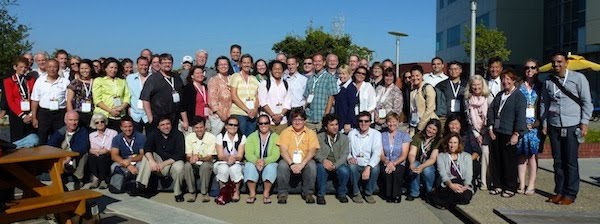
School may still be out for summer, but teachers remain hard at work. This week, we hosted Google’s inaugural Faculty Institute at our Mountain View, Calif. headquarters. The three-day event was created for esteemed faculty from schools of education and math and science to explore teaching paradigms that leverage technology in K-12 classrooms. Selected via a rigorous nomination and application process, the 39 faculty members hail from 19 California State Universities (CSUs), as well as Stanford and UC Berkeley, and teach high school STEM (Science, Technology, Engineering and Math) teachers currently getting their teaching credentials. CSU programs credential 60 percent of California’s teachers—or 10 percent of all U.S. K-12 teachers—and one CSU campus alone can credential around 1,000 new teachers in a year. The purpose of gathering together at the Institute was to ensure our teachers’ teachers have the support they need to help educators adjust to a changing landscape.

There is so much technology available to educators today, but unless they learn how to use it effectively, it does little to change what is happening in our classrooms. Without the right training and inspiration, interactive displays become merely expensive projection screens, and laptops simply replace paper rather than shifting the way teachers teach and students learn. Although the possibilities for technology use in schools are endless, teacher preparation for the 21st century classroom also has many constraints. For example: beyond the expense involved, there’s the time it costs educators to match a technological innovation to the improvement of pedagogy and curriculum; there’s a distinct shift in thinking that needs to take place to change classrooms; and there’s an essential challenge to help teachers develop the dispositions and confidence to be lifelong evaluators, learners and teachers of technology, instead of continuing to rely on traditional skill sets that will soon be outdated.

The Institute featured keynote addresses from respected professors from Stanford and Berkeley, case studies from distinguished high school teachers from across California, hands-on technology workshops with a variety of Google and non-Google tools, and panels with professionals in the tech-education industry. Notable guests included representatives from Teach for America, The New Teacher Project, the Department of Education and Edutopia. Topics covered the ability to distinguish learning paths, how to use technology to transform classrooms into project-based, collaborative spaces and how to utilize a more interactive teaching style rather than the traditional lecture model.

On the last day of the Institute, faculty members were invited to submit grant proposals to scale best practices outside of the meeting. Deans of the participating universities will convene at the end of the month to further brainstorm ways to scale new ideas in teacher preparation programs. Congratulations to all of the faculty members who were accepted into the inaugural Institute, and thank you for all that you do to help bring technology and new ways of thinking into the classroom.


This program is a part of Google’s continued commitment to supporting STEM education. Details on our other programs can be found on www.google.com/education.
Read More
Posted in Education | No comments

Wednesday, 10 August 2011

Culturomics, Ngrams and new power tools for Science

Posted on 15:51 by Unknown
Posted by Erez Lieberman Aiden and Jean-Baptiste Michel, Visiting Faculty at Google

Four years ago, we set out to create a research engine that would help people explore our cultural history by statistically analyzing the world’s books. In January 2011, the resulting method, culturomics, was featured on the cover of the journal Science. More importantly, Google implemented and launched a web-based version of our prototype research engine, the Google Books Ngram Viewer.

Now scientists, scholars, and web surfers around the world can take advantage of the Ngram Viewer to study a vast array of phenomena. And that's exactly what they've done. Here are a few of our favorite examples.

Poverty
Martin Ravallion, head of the Development Research Group at the World Bank, has been using the ngrams to study the history of poverty. In a paper published in the journal Poverty and Public Policy, he argues for the existence of two ‘poverty enlightenments’ marked by increased awareness of the problem: one towards the end of the 18th century, and another in the 1970s and 80s. But he makes the point that only the second of these enlightenments brought with it a truly enlightened idea: that poverty can be and should be completely eradicated.


The Science Hall of Fame
Adrian Veres and John Bohannon wondered who the most famous scientists of the past two centuries were. But there was no hall of fame for scientists, or a committee that determines who deserves to get into such a hall. So they used the ngrams data to define a metric for celebrity – the milliDarwin – and algorithmically created a Science Hall of Fame listing the most famous scientists born since 1800. They found that things like a popular book or a major controversy did more to increase discussion of a scientist than, for instance, winning a Nobel Prize.

(Other users have been exploring the history of particular sciences with the Ngram Viewer, covering everything from neuroscience to the nuclear age.)


The History of Typography
When we introduced the Ngram Viewer, we pointed out some potential pitfalls with the data. For instance, the ‘medial s’ ( ſ ), an older form of the letter s that looked like an integral sign and appeared in the beginning or middle of words, tends to be classified as an instance of the letter ‘f’ by the OCR algorithm used to create our version of the data. Andrew West, blogging at Babelstone, found a clever way to exploit this error: using queries like ‘husband’ and ‘hufband’ to study the history of medial s typography, he pinned down the precise moment when the medial s disappeared from English (around 1800), French (1780), and Spanish (1760).

People are clearly having a good time with the Ngram Viewer, and they have been learning a few things about science and history in the process. Indeed, the tool has proven so popular and so useful that Google recently announced that its imminent graduation from Google Labs to become a permanent part of Google Books.

Similar ‘big data’ approaches can also be applied to a wide variety of other problems. From books to maps to the structure of the web itself, 'the world's information' is one amazing dataset.

Erez Lieberman Aiden is Visiting Faculty at Google and a Fellow of the Harvard Society of Fellows. Jean-Baptiste Michel is Visiting Faculty at Google and a Postdoctoral Fellow in Harvard's Department of Psychology.
Read More
Posted in Google Books, Ngram | No comments

Thursday, 28 July 2011

President's Council Recommends Open Data for Federal Agencies

Posted on 10:58 by Unknown
Posted by Alon Halevy, Senior Staff Research Scientist

Cross-posted with the Public Sector and Elections Lab Blog

One of the things I most enjoy about working on data management is the ability to work on a variety of problems, both in the private sector and in government. I recently had the privilege of serving on a working group of the President’s Council of Advisors on Science and Technology (PCAST) studying the challenges of conserving the nation’s ecosystems. The report, titled “Sustaining Environmental Capital: Protecting Society and the Economy” was presented to President Obama on July 18th, 2011. The full report is now available to the public.

The press release announcing the report summarizes its recommendations:
The Federal Government should launch a series of efforts to assess thoroughly the condition of U.S. ecosystems and the social and economic value of the services those ecosystems provide, according to a new report by the President’s Council of Advisors on Science and Technology (PCAST), an independent council of the Nation’s leading scientists and engineers. The report also recommends that the Nation apply modern informatics technologies to the vast stores of biodiversity data already collected by various Federal agencies in order to increase the usefulness of those data for decision- and policy-making.

One of the key challenges we face in assessing the condition of ecosystems is that a lot of the data pertaining to these systems is locked up in individual databases. Even though this data is often collected using government funds, it is not always available to the public and in other cases available but not in usable formats. This is a classical example of a data integration problem that occurs in many other domains.

The report calls for creating an ecosystem, EcoINFORMA, around data. The crucial piece of this ecosystem is to make the relevant data publicly available in a timely manner and, most importantly, in a machine readable form. Publishing data embedded in a PDF file is a classical example of what does not count as being machine readable. For example, if you are publishing a tabular data set, then a computer program should be able to directly access the meta-data (e.g., column names, date collected) and the data rows without having to heuristically extract it from surrounding text.

Once the data is published, it can be discovered by search engines. Data from multiple sources can be combined to provide additional insight, and the data can be visualized and analyzed by sophisticated tools. The main point is that innovation should be pursued by many parties (academics, commercial, government), each applying their own expertise and passions.

There is a subtle point about how much meta-data should be provided before publishing the data. Unfortunately, requiring too much meta-data (e.g., standard schemas) often stymies publication. When meta-data exists, that’s great, but when it’s not there or is not complete, we should still publish the data in a timely manner. If the data is valuable and discoverable, there will be someone in the ecosystem who will enhance the data in an appropriate fashion.

I look forward to seeing this ecosystem evolve and excited that Google Fusion Tables, our own cloud-based service for visualizing, sharing and integrating structured data, can contribute to its development.
Read More
Posted in Fusion Tables, Government, Policy, Structured Data | No comments

Thursday, 21 July 2011

Studies Show Search Ads Drive 89% Incremental Traffic

Posted on 08:10 by Unknown
Posted by David Chan and Lizzy Van Alstine, Quantitative Management Team

Advertisers often wonder whether search ads cannibalize their organic traffic. In other words, if search ads were paused, would clicks on organic results increase, and make up for the loss in paid traffic? Google statisticians recently ran over 400 studies on paused accounts to answer this question.

In what we call “Search Ads Pause Studies”, our group of researchers observed organic click volume in the absence of search ads. Then they built a statistical model to predict the click volume for given levels of ad spend using spend and organic impression volume as predictors. These models generated estimates for the incremental clicks attributable to search ads (IAC), or in other words, the percentage of paid clicks that are not made up for by organic clicks when search ads are paused.

The results were surprising. On average, the incremental ad clicks percentage across verticals is 89%. This means that a full 89% of the traffic generated by search ads is not replaced by organic clicks when ads are paused. This number was consistently high across verticals. The full study can be found on here.
Read More
Posted in search ads | No comments

Wednesday, 20 July 2011

Faculty from across the Americas meet in New York for the Faculty Summit

Posted on 11:08 by Unknown
Posted by Maggie Johnson, Director of Education & University Relations

(Cross-posted from the Official Google Blog)

Last week, we held our seventh annual Computer Science Faculty Summit. For the first time, the event took place at our New York City office; nearly 100 faculty members from universities in the U.S., Canada and Latin America attended. The two-day Summit focused on systems, artificial intelligence and mobile computing. Alfred Spector, VP of research and special initiatives, hosted the conference and led lively discussions on privacy, security and Google’s approach to research.

Google’s Internet evangelist, Vint Cerf, opened the Summit with a talk on the challenges involved in securing the “Internet of things”—that is, uniquely identifiable objects (“things”) and their virtual representations. With almost 2 billion international Internet users and 5 billion mobile devices out there in the world, Vint expounded upon the idea that Internet security is not just about technology, but also about policy and global institutions. He stressed that our new digital ecosystem is complex and large in scale, and includes both hardware and software. It also has multiple stakeholders, diverse business models and a range of legal frameworks. Vint argued that making and keeping the Internet secure over the next few years will require technical innovation and global collaboration.

After Vint kicked things off, faculty spent the two days attending presentations by Google software engineers and research scientists, including John Wilkes on the management of Google's large hardware infrastructure, Andrew Chatham on the self-driving car, Johan Schalkwyk on mobile speech technology and Andrew Moore on the research challenges in commerce services. Craig Nevill-Manning, the engineering founder of Google’s NYC office, gave an update on Google.org, particularly its recent work in crisis response. Other talks covered the engineering work behind products like Ad Exchange and Google Docs, and the range of engineering projects taking place across 35 Google offices in 20 countries. For a complete list of the topics and sessions, visit the Faculty Summit site. Also, a few of our attendees heeded Alfred’s call to recap their breakout sessions in verse—download a PDF of one of our favorite poems, about the future of mobile computing, penned by NYU professor Ken Perlin.

A highlight of this year’s Summit was Bill Schilit’s presentation of the Library Wall, a Chrome OS experiment featuring an eight-foot tall full-color virtual display of ebooks that can be browsed and examined individually via touch screen. Faculty members were invited to play around with the digital-age “bookshelf,” which is one of the newest additions to our NYC office.

We’ve already posted deeper dives on a few of the talks—including cluster management, mobile search and commerce. We also collected some interesting faculty reflections. For more information on all of our programs, visit our University Relations website. The Faculty Summit is meant to connect forerunners across the computer science community—in business, research and academia—and we hope all our attendees returned home feeling informed and inspired.
Read More
Posted in conference, University Relations | No comments
Newer Posts Older Posts Home
Subscribe to: Posts (Atom)

Popular Posts

  • Our Faculty Institute brings faculty back to the drawing board
    Posted by Nina Kim Schultz, Google Education Research Cross-posted with the Official Google Blog School may still be out for summer, but tea...
  • Academic Successes in Cluster Computing
    Posted by Alfred Spector, VP of Research Access to massive computing resources is foundational to Research and Development. Fifteen awardees...
  • Towards Energy-Proportional Datacenters
    Posted by Dennis Abts, Michael R. Marty, Philip M. Wells, Peter Klausler, and Hong Liu This is part of the series highlighting some notable...
  • International Conference on Machine Learning (ICML 2009) in Montreal
    Posted by Eyal Even Dar and Vahab Mirrokni , Google Research, NY The 26th International Conference on Machine Learning ( ICML 2009 ) was re...
  • A new landmark in computer vision
    Posted by Jay Yagnik, Head of Computer Vision Research [Cross-posted with the Official Google Blog ] Science fiction books and movies have l...
  • Market Algorithms and Optimization Meeting
    Posted by  Vahab S. Mirrokni and Muthu Muthukrishnan Google auctions ads, and enables a market with millions of advertisers and users.  This...
  • Education Awards on Google App Engine
    Posted by Andrea Held, Google University Relations Cross-posted with Google Developers Blog Last year we invited proposals for innovative p...
  • Speed Matters
    Posted by Jake Brutlag, Web Search Infrastructure At Google, we've gathered hard data to reinforce our intuition that "speed matter...
  • Google launches Korean Voice Search
    Posted by Mike Schuster & Martin Jansche, Google Research On June 16th, we launched our Korean voice search system . Google Search by Vo...
  • Two Views from the 2009 Google Faculty Summit
    Posted by Alfred Spector, Vice President of Research and Special Initiatives [cross-posted with the Official Google Blog ] We held our fifth...

Categories

  • accessibility
  • ACL
  • ACM
  • Acoustic Modeling
  • ads
  • adsense
  • adwords
  • Africa
  • Android
  • API
  • App Engine
  • App Inventor
  • Audio
  • Awards
  • Cantonese
  • China
  • Computer Science
  • conference
  • conferences
  • correlate
  • crowd-sourcing
  • CVPR
  • datasets
  • Deep Learning
  • distributed systems
  • Earth Engine
  • economics
  • Education
  • Electronic Commerce and Algorithms
  • EMEA
  • EMNLP
  • entities
  • Exacycle
  • Faculty Institute
  • Faculty Summit
  • Fusion Tables
  • gamification
  • Google Books
  • Google+
  • Government
  • grants
  • HCI
  • Image Annotation
  • Information Retrieval
  • internationalization
  • Interspeech
  • jsm
  • jsm2011
  • K-12
  • Korean
  • Labs
  • localization
  • Machine Hearing
  • Machine Learning
  • Machine Translation
  • MapReduce
  • market algorithms
  • Market Research
  • ML
  • MOOC
  • NAACL
  • Natural Language Processing
  • Networks
  • Ngram
  • NIPS
  • NLP
  • open source
  • operating systems
  • osdi
  • osdi10
  • patents
  • ph.d. fellowship
  • PiLab
  • Policy
  • Public Data Explorer
  • publication
  • Publications
  • renewable energy
  • Research Awards
  • resource optimization
  • Search
  • search ads
  • Security and Privacy
  • SIGMOD
  • Site Reliability Engineering
  • Speech
  • statistics
  • Structured Data
  • Systems
  • Translate
  • trends
  • TV
  • UI
  • University Relations
  • UNIX
  • User Experience
  • video
  • Vision Research
  • Visiting Faculty
  • Visualization
  • Voice Search
  • Wiki
  • wikipedia
  • WWW
  • YouTube

Blog Archive

  • ▼  2013 (51)
    • ▼  December (3)
      • Groundbreaking simulations by Google Exacycle Visi...
      • Googler Moti Yung elected as 2013 ACM Fellow
      • Free Language Lessons for Computers
    • ►  November (9)
    • ►  October (2)
    • ►  September (5)
    • ►  August (2)
    • ►  July (6)
    • ►  June (7)
    • ►  May (5)
    • ►  April (3)
    • ►  March (4)
    • ►  February (4)
    • ►  January (1)
  • ►  2012 (59)
    • ►  December (4)
    • ►  October (4)
    • ►  September (3)
    • ►  August (9)
    • ►  July (9)
    • ►  June (7)
    • ►  May (7)
    • ►  April (2)
    • ►  March (7)
    • ►  February (3)
    • ►  January (4)
  • ►  2011 (51)
    • ►  December (5)
    • ►  November (2)
    • ►  September (3)
    • ►  August (4)
    • ►  July (9)
    • ►  June (6)
    • ►  May (4)
    • ►  April (4)
    • ►  March (5)
    • ►  February (5)
    • ►  January (4)
  • ►  2010 (44)
    • ►  December (7)
    • ►  November (2)
    • ►  October (9)
    • ►  September (7)
    • ►  August (2)
    • ►  July (7)
    • ►  June (3)
    • ►  May (2)
    • ►  April (1)
    • ►  March (1)
    • ►  February (1)
    • ►  January (2)
  • ►  2009 (44)
    • ►  December (8)
    • ►  November (4)
    • ►  August (4)
    • ►  July (5)
    • ►  June (5)
    • ►  May (4)
    • ►  April (6)
    • ►  March (3)
    • ►  February (1)
    • ►  January (4)
  • ►  2008 (11)
    • ►  December (1)
    • ►  November (1)
    • ►  October (1)
    • ►  September (1)
    • ►  July (1)
    • ►  May (3)
    • ►  April (1)
    • ►  March (1)
    • ►  February (1)
  • ►  2007 (9)
    • ►  October (1)
    • ►  September (2)
    • ►  August (1)
    • ►  July (1)
    • ►  June (2)
    • ►  February (2)
  • ►  2006 (15)
    • ►  December (1)
    • ►  November (1)
    • ►  September (1)
    • ►  August (1)
    • ►  July (1)
    • ►  June (2)
    • ►  April (3)
    • ►  March (4)
    • ►  February (1)
Powered by Blogger.

About Me

Unknown
View my complete profile